| Case Name: | Case of Acoustic Imaging Detection for Insulator Fouling and Partial Discharge in Distribution Rooms |
| Industry Field: | Power / Transmission and Transformation Maintenance |
| Detection Objects: | Insulators of transmission lines, cable joints |
| Distribution cabinets, universal circuit breakers, indoor transformers in distribution rooms | |
| Equipment Used: | 128-channel acoustic imaging instrument (Model: AC-D128PD) |
| Detection Date: | January 23, 2026 |
| Detection Location: | Cable terminal head in Guangzhou, Power Center in Guangzhou |
I. Application Background
(1) Field Background
During the operation of transmission lines, the surface of insulators or cable joints is prone to accumulate dust and
contaminants due to environmental factors. Under conditions of humidity and haze,
the insulation resistance decreases, which can lead to flashover and accompanied by partial discharge.
Meanwhile, in distribution rooms of power supply centers, distribution cabinets, universal circuit breakers,
and indoor transformers,which have been operating for a long time,
may generate partial discharge due to insulation aging and poor contact, but such issues often do
not show obvious temperature rise characteristics in the early stage.
(2) Customer Core Requirements
① Discover early signs of fouling and discharge during equipment operation.
② Conduct condition inspection of transmission lines and distribution room equipment.
③ Make up for the shortcomings of infrared detection in early discharge scenarios.
④ Provide intuitive, recordable, and comparable detection results.
II. Detection Challenges
① The acoustic signals of fouling and partial discharge are relatively weak.
② The structures of transmission lines and distribution equipment are complex.
③ The space in distribution rooms is limited, and the detection angle is restricted.
④ It is difficult to detect abnormalities in the early discharge stage using infrared thermal imaging.
III. Solution and Detection Method
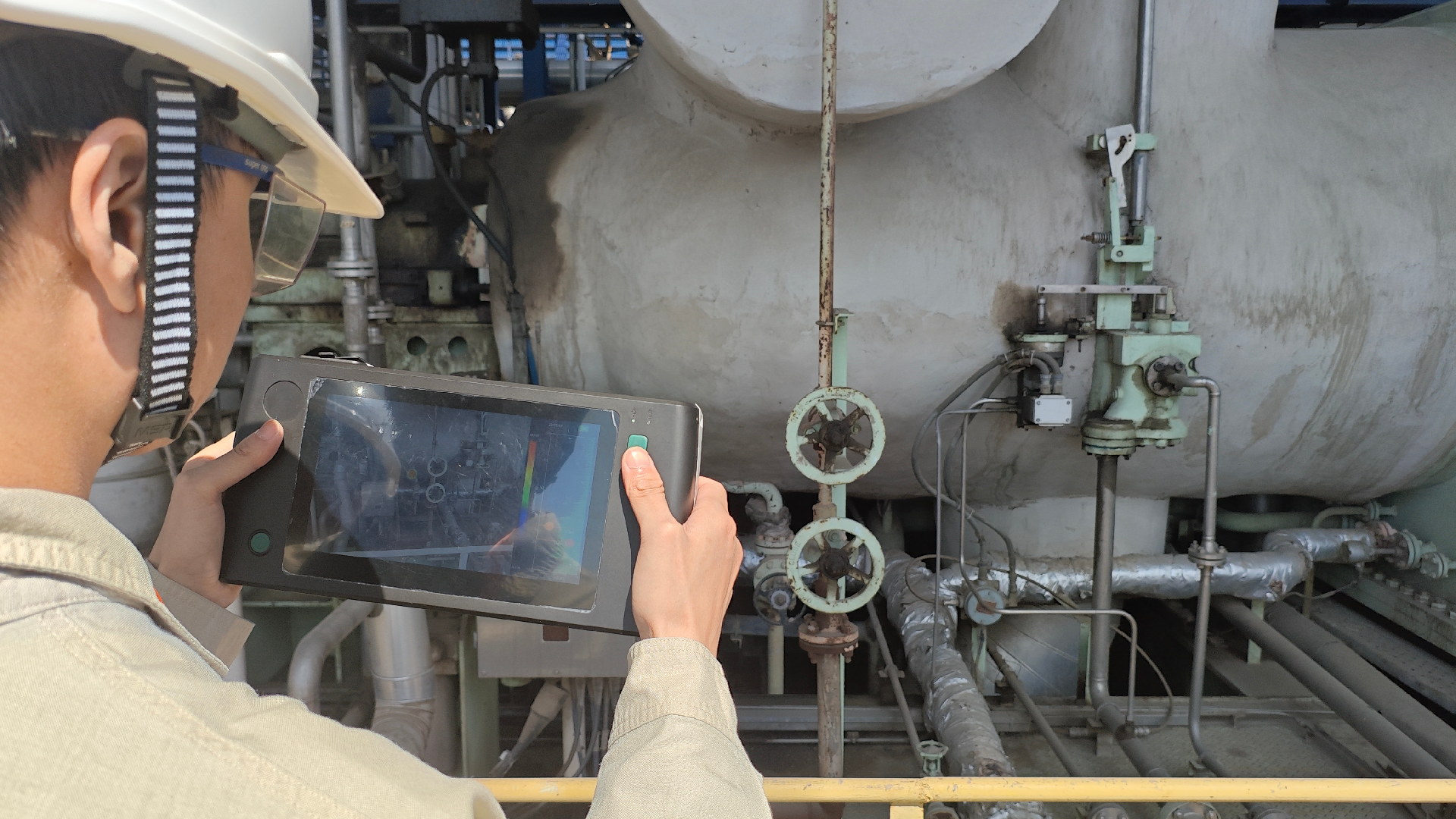
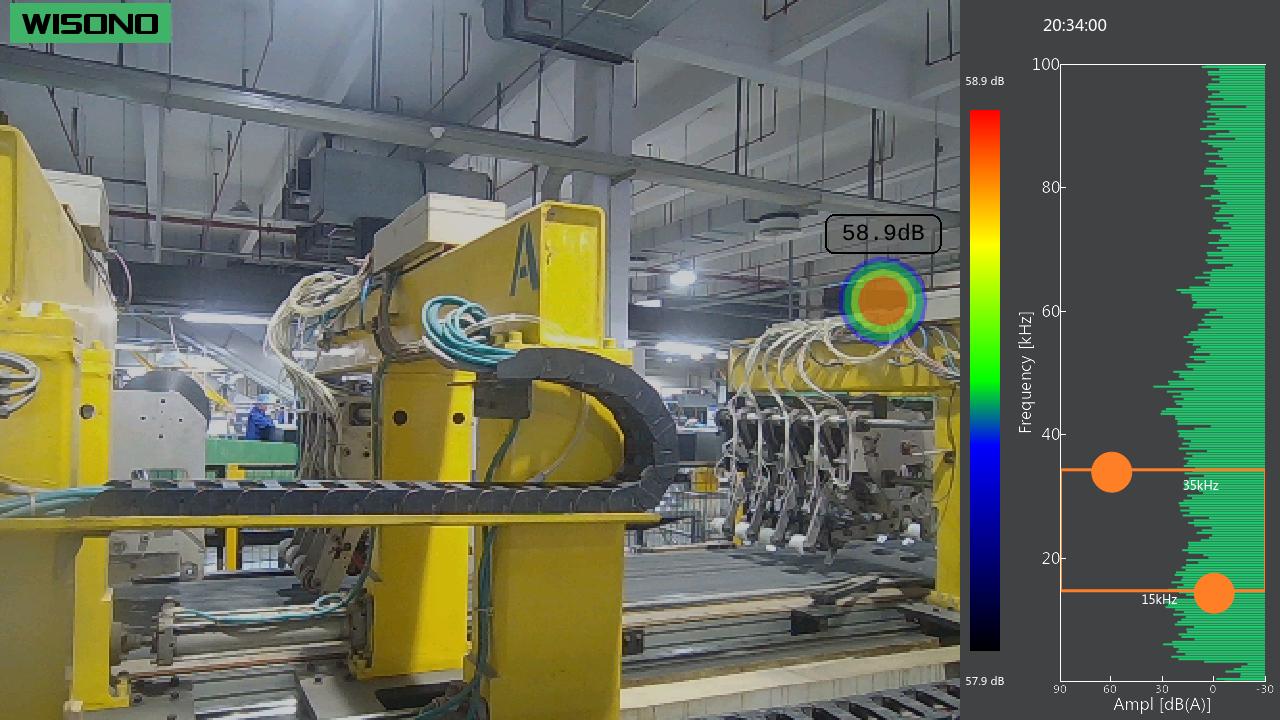
Using the 128-channel acoustic imaging instrument independently developed by Wisono Technology Co., Ltd. (Model: AC-D128PD), a non-contact, long-distance,
and visual acoustic source positioning method is adopted. By capturing the characteristic acoustic signals generated by fouling and partial discharge for positioning,
combined with acoustic imaging diagrams and PRPD (Phase Resolved Partial Discharge) diagrams for comprehensive judgment.
Detection Method Description:
① Conduct fixed-point scanning of insulators and cable joints of transmission lines;
② Open the cabinets of distribution equipment in the distribution room under safe conditions for detection;
③ Conduct multi-angle scanning of suspected discharge areas within an appropriate detection distance.
Characteristics:
① Abnormalities can be detected before the infrared temperature rise occurs;
② Non-contact detection, suitable for use in energized conditions;
③ Acoustic imaging and PRPD graphs are mutually verified to enhance the reliability of judgment;
IV. Explanation of the on-site detection process
1. Insulator and cable joint contamination flashover detection of transmission lines
① Conduct inspection of insulators and cable joints of transmission lines;
② Use acoustic imaging instrument to scan the suspected contamination flashover area;
③ Local abnormal sound source distribution appears in the acoustic image.
④ Preliminary judgment of contamination flashover discharge phenomenon;
2. Partial discharge detection of equipment in distribution rooms
① Inspect distribution cabinets, universal circuit breakers, and indoor transformers;
② With safety measures in place, open the cabinet door for detection;
③ Acoustic imaging instrument identifies abnormal sound source areas in the cabinet.
④ Signals consistent with partial discharge characteristics are displayed in the PRPD graph;
⑤ Conduct comparative detection using infrared thermal imaging instrument, no obvious abnormal temperature rise is found;
V. Display of detection results and effects
Detection results: Successfully identified contamination flashover signals at the insulator and cable joint of transmission lines.
Early partial discharge phenomena were detected in multiple distribution equipment in the distribution room.
The discharge signals were reflected in both the acoustic imaging image and the PRPD graph.
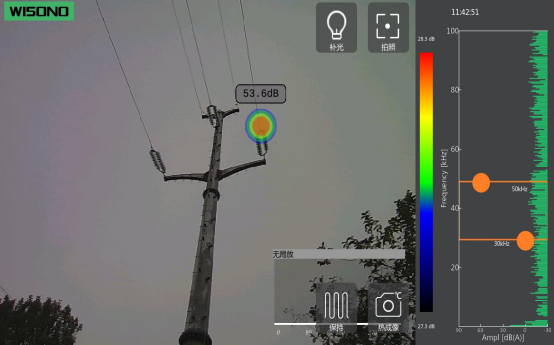
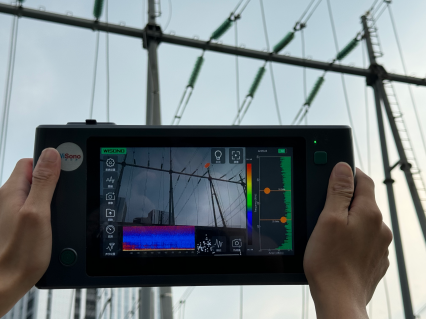
Figure 1 Actual measurement of corona discharge at cable terminals
If there is dust at the insulator or cable joint, it may cause discharge phenomena.
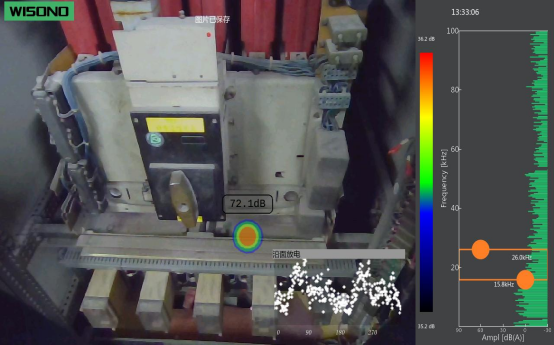
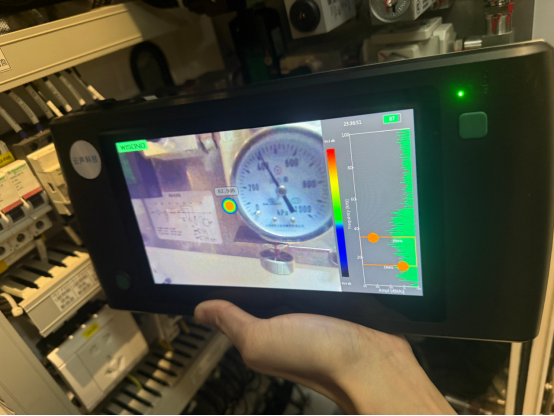
Figure 2-1 Measured data of universal circuit breaker (front view of the circuit breaker)
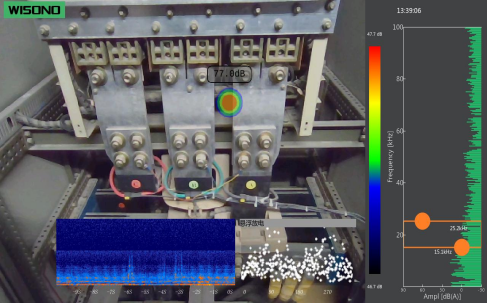
Figure 2-2 Measured data of universal circuit breaker (back of the circuit breaker)
When testing the universal circuit breaker, the sounds produced by the equipment include: the sound of the equipment itself operating and the sound of partial discharge.
Due to the loud sound of the equipment itself, the partial discharge signal is drowned out.
The location of the light spot is determined as the source of the strongest sound emitted by the equipment,
but the PRPD graph can still analyze that the sound signal collected contains the partial discharge signal.
Using an infrared thermal imager for detection revealed that there was no partial discharge phenomenon.
Therefore, during the testing process, a known normal universal circuit breaker was replaced immediately.
The PRPD graph of the sound image analyzer no longer indicated the presence of partial discharge,
and the human ear could hear that the sound emitted by the equipment was different from before the replacement.
At this point, it can be found that the sound image analyzer can detect early partial discharge phenomena,
and the temperature rise was not obvious, and the thermal imager could not detect the early partial discharge defect.
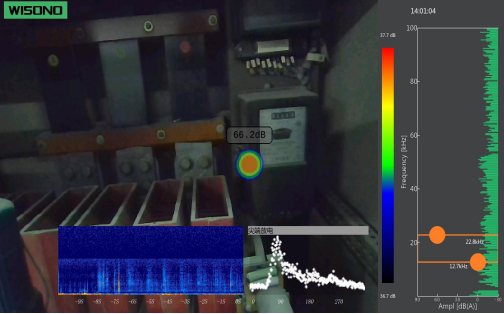
Figure 3: Partial discharge (tip discharge) detected inside the distribution cabinet
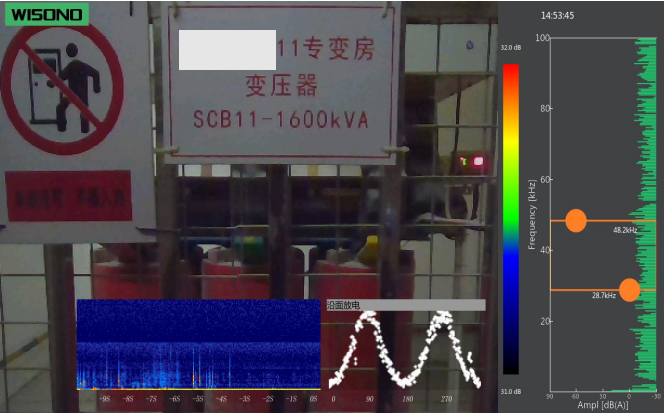
Figure 4: Partial Discharge Detected in the Transformer in the Distribution Room (Surface Discharge)
There are two distribution rooms, and the transformers inside are the same. The PRPD graph of the sound image sensor in the right room indicates
the occurrence of partial discharge, but due to the limited detection angle (safety factor), the specific location of the partial discharge cannot be determined.
Entering the left room, the sound image sensor does not indicate the occurrence of partial discharge, and the PRPD graph does not show anything,
but the human ear can clearly hear that the sounds produced by the two transformers are different. It is expected that the right room transformer
will be the focus of the next maintenance.
VI. Comparison and Analysis of Detection Methods
| Detection Method | Detection Effect |
| Acoustic Imaging | Can detect early discharge and pollution flashover signals, with intuitive positioning |
| And the PRPD analysis can confirm the type and characteristics of the discharge | |
| Infrared Thermal Imaging | No obvious temperature rise in the early stage, making it difficult to detect |
VII. Customer Feedback and Application Value
① The customer recognizes the practicality of the acoustic imaging technology in the detection of pollution flashover and early partial discharge.
② They believe that this method effectively compensates for the deficiency of infrared detection in the identification of early hazards.
③ It is suitable for the status patrol of distribution rooms and lines in power supply centers.
④ They express recognition of the detection method combining acoustic imaging and PRPD.